
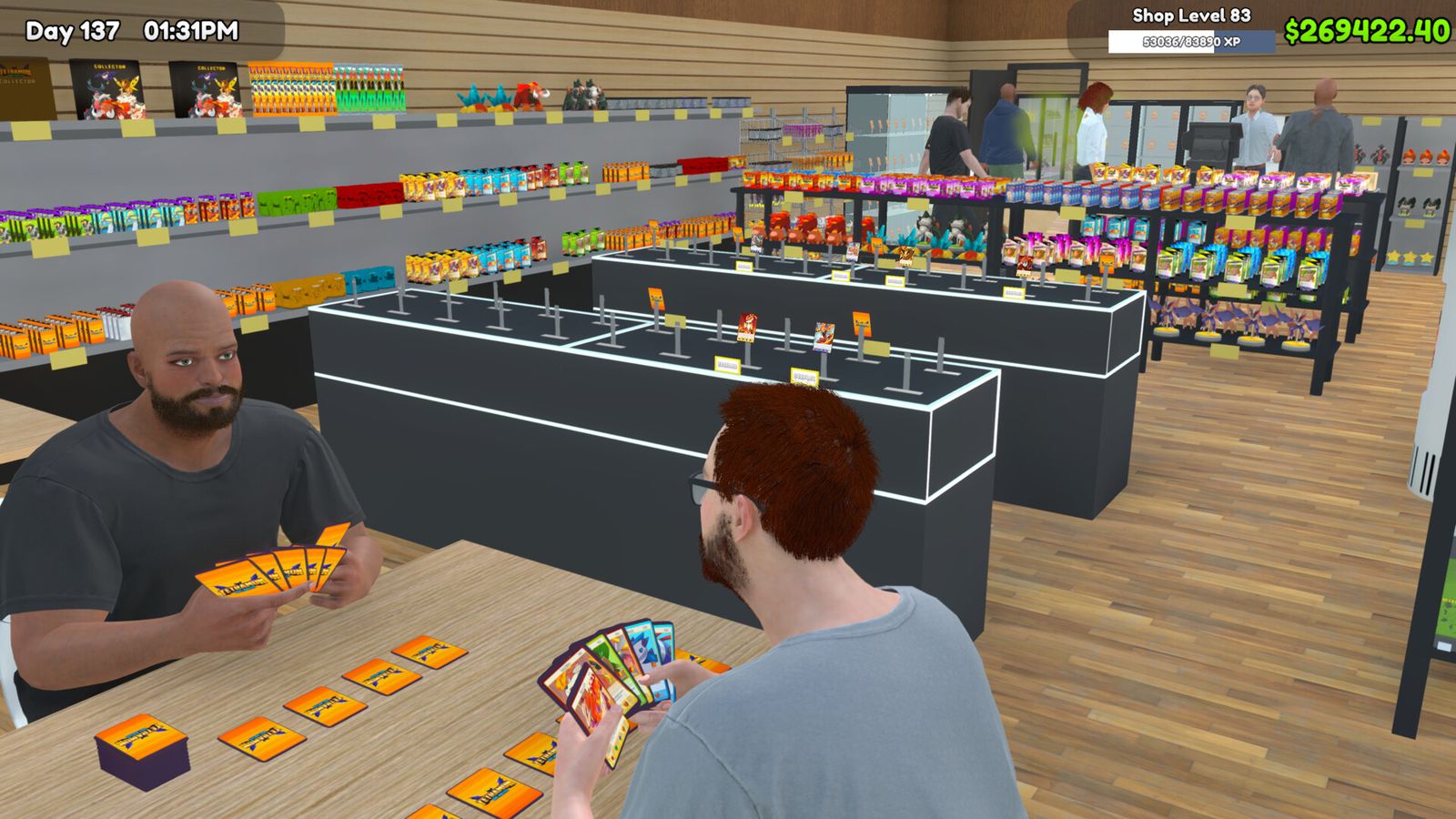
TCG Card Shop Simulator Beginner Guide: Your First Days
What to stock, how to price it, how to stop smelly customers, and which upgrades pay for themselves in the first days of TCG Card Shop Simulator.

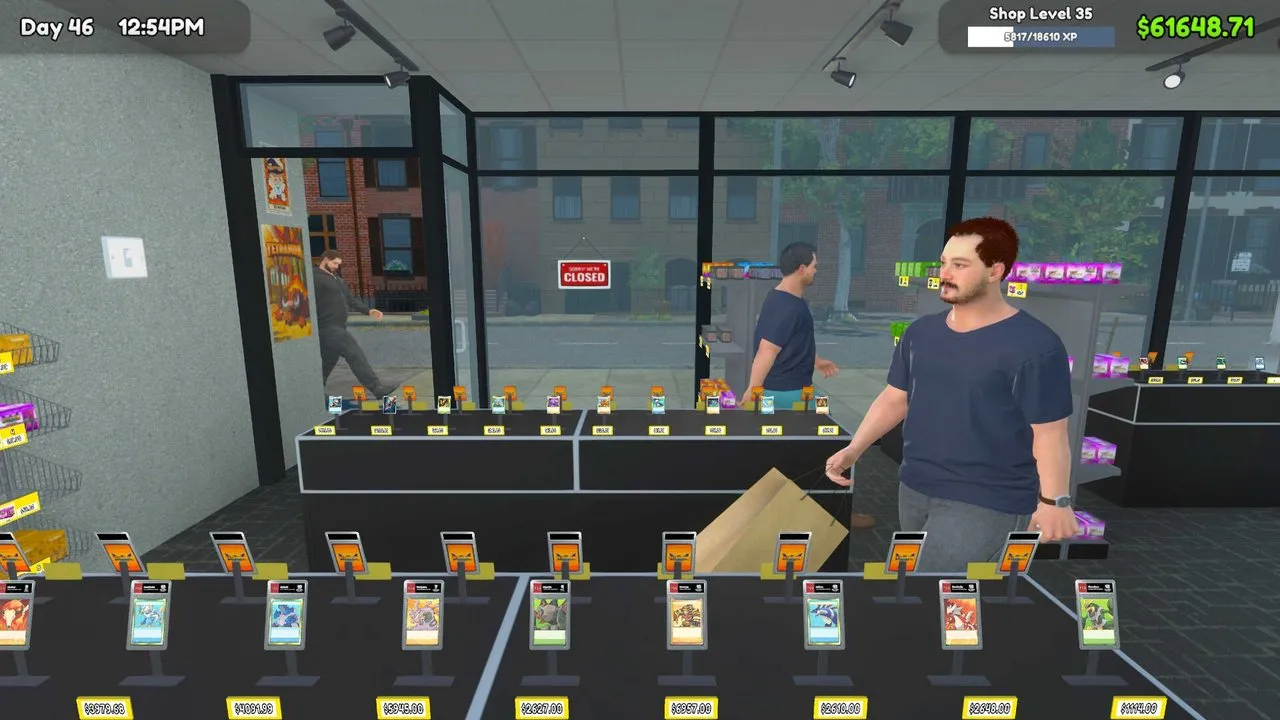
You do not need a full shop to make money. You need one product line, full shelves and a fast checkout. Everything else in TCG Card Shop Simulator is a distraction until those three things work.
That is the short answer. Here is the order to do it in, with the version each tip was checked against.
Sell one thing, not everything
Pick the most expensive product you have unlocked and put it on every shelf you own. Skip the cheap packs.
Two creators tested this separately and reached the same conclusion. Tenkiei Gaming emptied a level 38 shop down to deck boxes and recorded $44,460 in one day, with roughly $25,000 of that counting as profit. Keldor did the same with a single row of Epic Destiny boxes and cleared about $48,000 profit in one day.
The reason is simple. Customers buy more when a shelf holds more of the same item. Their purchase roll scales with how many units sit on that spot. A shelf with eight of one product beats eight different products spread across the shop.
| Early decision | Do this | Why |
|---|---|---|
| Product range | One high-margin line | More units per shelf means bigger baskets |
| Price | Market price, rounded | Round numbers speed up checkout |
| Card tables | Store them away | Tables pull customers away from shelves |
| Employees | Stocking only, not checkout | Early staff are slow on the register |
Price at market and round the number
Selling at market price gives the best chance a customer actually buys. Push much above it and they walk away.
Rounding matters for a different reason. Cash customers make you count out change. Set prices to whole numbers and every checkout moves faster, which means more customers through the door.
Block the smelly customers at the entrance
Some customers arrive with a smell that drives other shoppers out. You need the Cleanser licence, then a scent machine near the door.
Place a shelf so incoming customers cannot walk around the sprayer. Keldor’s setup catches almost everyone this way, while Its_Phantom_Fam reports only about one customer slipping past every few days. The cheapest M100 unit needs two sprays per customer, so a single unit is not enough during a rush.
The G500 and T1000 clean a customer in one spray. Upgrade when you can afford it.
Shelf capacity matters more than you think. A $150 small cabinet holds 48 units. A plain shelf holds 32. The wide shelf that unlocks at level 30 holds 64. Empty shelves are worse than useless, because a customer can waste a whole visit on them.
Check out customers yourself until level 25
Early employees are slow. Put them on stocking and stay on the register.
Zackery Cole unlocks at level 10 and costs $500 to hire plus $50 a day. His checkout speed is the slowest in the game. Clark Cash arrives at level 25 and is the first employee worth putting on a register.
Two registers help once traffic picks up, because your goal is to get people in and out as fast as possible so new customers can spawn.
Opening packs: what actually matters
Opening speed is a setting. Press Escape, open Settings, then Speed, and raise it to maximum. The animation still pauses on cards above $10, which is exactly the moment you want to look.
Two things worth knowing before you buy your first case.
- Pulling packs out of a box does not improve your odds. The chance is identical whether you open a loose pack or one from a case.
- Pack-opening experience follows card rarity, not card value. Cheap packs level your shop just as well when you are grinding experience.
What to do with the cards you open
Keep anything rare. Sell duplicates.
Community guides are consistent about this, because the collection achievements are the real long grind. One creator suggests holding every full-art foil and EX foil rather than cashing them in. Those two groups are the bottleneck for the 2,500-card and 4,000-card milestones.
Everything worth under a dollar should go into a bulk bundle at the workbench rather than onto a shelf.
The workbench unlocks at level 7
The workbench is where you build bulk bundles, and since 1.0 it is also where you read the Tetramon rulebook and edit decks. Level 7 is early, but not instant, so plan your first two days around reaching it.
Limits worth knowing
Most of the numbers above come from player testing recorded during Early Access builds 0.43 to 0.46. Patch 1.0 changed card values and added the Ascension set, so treat exact figures as a starting point rather than fixed rules. Shelf capacities and scent-machine prices are community data, not published figures.
Related Articles
guide
TCG Card Shop Simulator Money Guide: What Actually Sells
Which products carry the best margin in TCG Card Shop Simulator, how high you can price them, and what to do with cheap cards that never sell.
mods
TCG Card Shop Simulator Mods: Install BepInEx Without Breaking the Game
How modding works in TCG Card Shop Simulator: BepInEx setup, the components content mods need, and why patch 1.0 broke most of the old mod list.